


Evento
AMclub | Brescia and Botticino
Brescia (BS)
Saturday 30.09.2023 at
The prestigious AMClub events are back with in-depth studies of excellence related to the Lombardy region accompanied by Art Historian Prof. Leonardo Catalano.
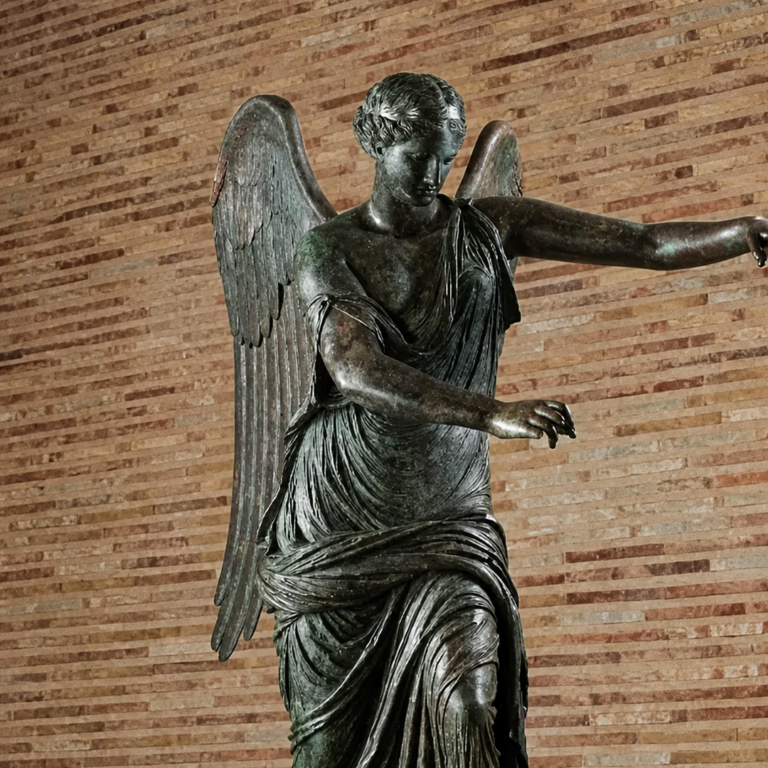
On Saturday 30 September we will be in Brescia to discover the artistic wonders produced over the millennia in ancient Brixia. This time, however, we will go to the origin of the refined Botticino marble directly by exclusively visiting the quarries and the adjoining museum. It will also be a tasty occasion to celebrate “the meeting” between the famous Winged Victory and the Boxer, a precious bronze loan from the Roman National Museum
Botticino and the ancient history of marble
Marmo Botticino is a Brescian excellence known throughout the world since ancient times, so much so that it was already used by the Romans in the 1st century B.C. to make capitals in the Forum. In more recent times it has been used for the construction of symbolic buildings and monuments, such as the Altar of the Fatherland in Rome, the White House in Washington, the Statue of Liberty and the Central Station in New York! A visit to the quarry allows one to understand the geology of the area, the mining techniques and the peculiarities that characterise the foothill area extending east of the city of Brescia. The museum tour will delve into the different aspects related to the extraction, transport and use of marble for buildings and sculptures, thus introducing the focus of the afternoon tour in Brescia.
Brescia and the search for precious materials from the ancient world
The second part of the day will be devoted to a focus visit to the Museum of Santa Giulia and the Capitolium. We will re-examine those marbles seen in the morning and compare them with others in both the Capitolium and the Museum of Santa Giulia. In addition to Botticino marble, we will find other “exotic” ones used since Roman Brescia to decorate floors or statues.
The Capitolium, with its recent restoration and redevelopment work, shows how, right from the foundations of its buildings (see the ancient theatre), marble was fundamental: from the finely sculpted capitals to the entablatures to the tombstones and commemorative inscriptions, everything speaks of the grandeur of the ancient world. In Santa Giulia, we also find ancient stones in the famous Domus dell'Ortaglia complex: columns in the cubicula (the ancient Roman bedrooms) to the famous peristyles around the gardens.
In the city's historic centre, Botticino marble was also abundantly used in more recent times (from the Middle Ages until the 20th century). Just think of the famous Palazzo di Città Piazza della Loggia or the many buildings in Piazza della Vittoria.
Marbles versus bronzes and ivories
The day of in-depth study of ancient technologies applied to art will allow us to comment on other important artefacts. In fact, it will be an opportunity to compare the famous Winged Victory with the Boxer, both made of precious and rare bronze and for the first time displayed in the Capitolium cell. The Resting boxer, One of the highest quality bronzes to have come down to us from the ancient world, it was found in 1885 on the slopes of the Quirinal, hidden between the foundation walls of a temple. It depicts a boxer in the moment of rest after a competition, seated with his legs apart and his forearms resting on his thighs. Critics are not unanimous in dating this masterpiece between the 4th and 1st century BC. The statue was made of bronze using the lost-wax casting technique and was loaned by the Roman National Museum. The two works will dialogue on one occasion. Other gilded bronzes will be analysed in the Museo di Santa Giulia where a “procession” of portrait heads has been dialoguing with posterity for some two thousand years! Finally, we will observe, again in the museum of Santa Giulia, the precious and rare ivory diptych tables of Roman production.
Programme of the day:
Meeting of participants at the bus shelter of the Cascina Gobba MM2 Milan stop and departure at 07.30.
Arrival at the Botticino quarries and guided tour of the quarries. Followed by a visit to the Botticino Museum. Departure for Brescia and free time for lunch. Admission with reservation from H 14.50 in the Museums of Santa Giulia and at the Capitolium.
NB Comfortable shoes and an umbrella are recommended for the morning walk (the guided tour of the quarry can take place in good weather. Entrance to the Botticino Museum is however guaranteed). Given the nature of the walk, which is easy but does not have architectural barriers in the quarry area, the route is not recommended for those with walking problems.
Return to Milan at Cascina Gobba by about 8 p.m.
- Cost of the tour for non-subscribers: € 89.00
- Cost of the tour for holders of Abbonamento Musei Lombardia Valle d'Aosta: € 69,00
INFO AND RESERVATIONS
In cooperation with:








 Digital Assistant